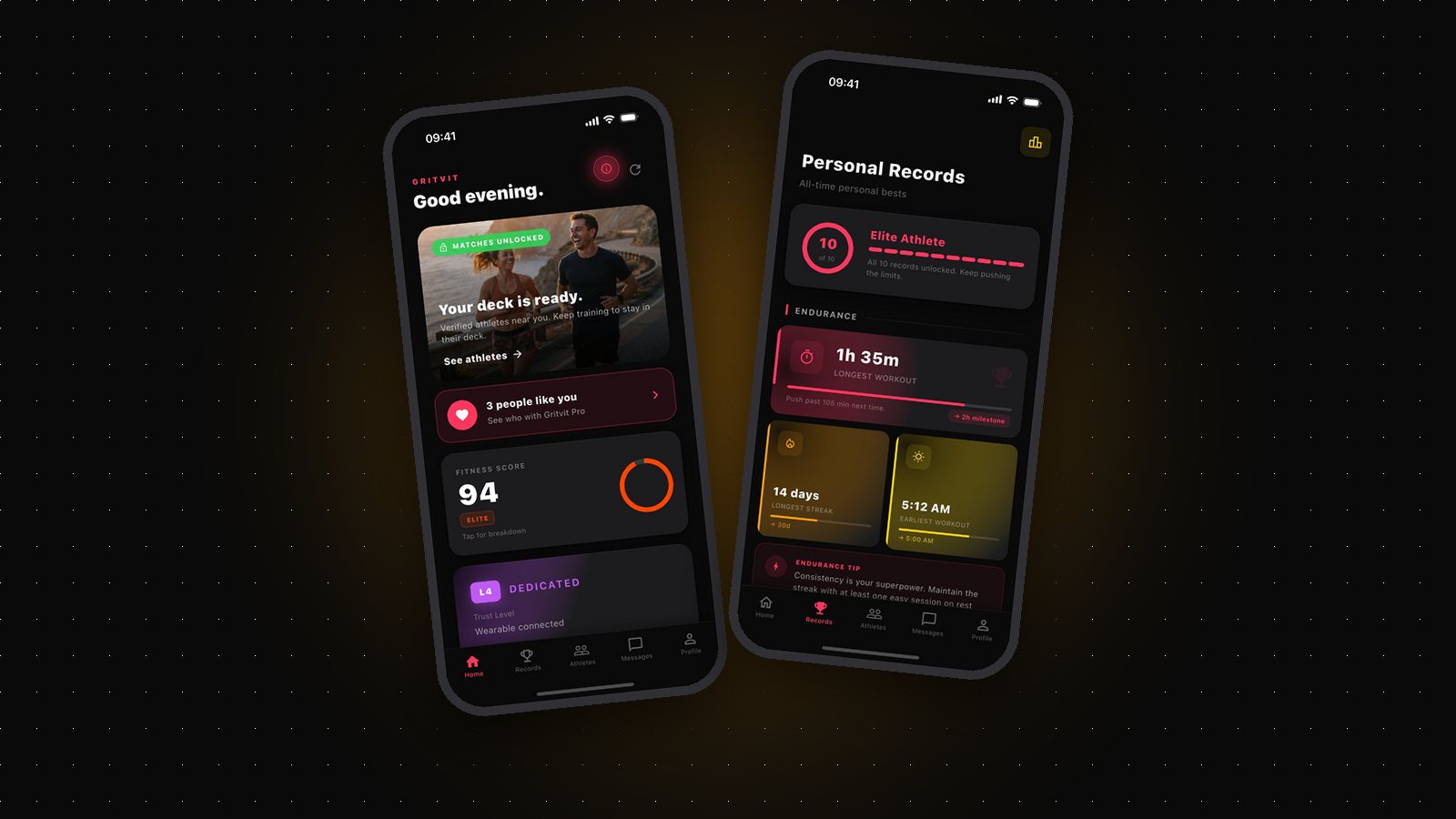
Your Fitness Score (0–100) is the most visible number on your Gritvit profile — a verified reflection of how you've been training, built from eight signals: resting heart rate, workout frequency, cardio volume, recency, daily steps, active calories, longest workout, and daily distance. It's not a fitness test and it's not a max-effort ranking; it's a picture of how you've actually been training lately.
Because the score is computed from real workout data, there are no tricks for raising it. But there are real levers, and a few common mistakes that hold people's scores below their actual training. Here's how to make the number match the work.
First, make sure your workouts are counted
The most common Fitness Score problem has nothing to do with fitness. Gritvit reads workouts from Apple Health on your iPhone — it never asks you to log anything manually. Which means a workout that never reaches Apple Health is invisible, no matter how hard it was.
Check your setup once and the problem disappears: Gritvit needs health permissions granted, and your tracker — Apple Watch, Garmin, Fitbit, or your phone's GPS — needs to be writing workouts into Apple Health. If you train without tracking, start tracking. The gym session you didn't record does nothing for your score.
Consistency beats heroics
Workout frequency and recency together carry more weight than any single big session, and consistency is the lever people underrate. A steady week of sessions serves your score better than one monster workout followed by silence — because the silence is what the decay system responds to.
This is convenient, because it's also how good training works. The score isn't asking you to do anything sports science wouldn't already recommend: regular sessions, sustainable volume, repeated weeks. Train like someone building a habit rather than someone cramming for an exam, and the score follows.
Know the decay timeline
Your score doesn't just rise — it falls when you stop, on a defined schedule:
- Day 3 without activity — your score starts to decay and you get a warning. This is your nudge.
- Day 5 — your matches start pausing, and you're hidden from other people's decks until you're back above an activity goal.
- Day 8 — your Fitness Score resets.
Use the decay, don't fear it
The timeline above looks like a threat, but read it again: your matches are safe until day five, and a day or two off doesn't trigger anything. That's room for genuine rest days — recovery is part of training, and the system is built to accommodate it. A normal training week with rest days built in never touches the decay at all.
Where the decay helps you is the gray zone every athlete knows: day four of "I'll train tomorrow." The 3-day warning is an accountability partner that never forgets. Plenty of habits die in the second week of a motivation dip; a visible number that responds to your absence is a surprisingly effective reason to lace up.
The honest summary
Improving your Fitness Score reduces to three moves: track every session so it counts, train consistently at a volume you can sustain, and never let a break stretch past the warning without a plan to return. There is no fourth move, and that's by design — a score you could game would be worthless to everyone who sees it.
The best way to think about it: the score isn't the goal. It's a mirror. Take care of the training and the number takes care of itself.